What Did Thomas Eakins Believe Was a Prerequisite for His Art?
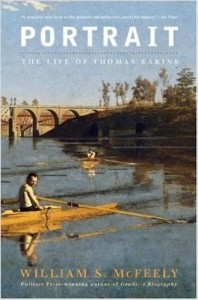 Portrait: The Life of Thomas Eakins
William Due south. McFeely
W. W. Norton. 237 pages, $26.95
A painter and photographer who's acclaimed by some critics as the best portrait artist in American history, Thomas Eakins is today a very hot property. His 1875 painting The Gross Clinic, which depicts Dr. Samuel Gross performing surgery, is still in the news. Purchased by Thomas Jefferson Academy in 1878 for $200, the Philadelphia Museum of Fine art has recently fended off a bid for the painting rumored to be $68 meg. Once considered as well gory for full general display, illustrating as it does Eakins' thorough understanding of beefcake, it is now considered by some to exist the greatest 19th-century American painting.
Eakins was born into comfortable circumstances in Philadelphia in 1844. His father, with whom he was very shut, nurtured his son's creative abilities. His mother was probably manic-depressive, and Eakins' ain depression increased as he grew older. Ceremonious War historian William McFeely, who won a Pulitzer for his biography of Ulysses S. Grant in 1981, has written, if non a hagiography, a very sympathetic and gay-affirming book about Eakins' life and work. Portrait proceeds in chronologic lodge with an emphasis on Eakins' youth, notably his rigorous art studies in France and Spain for four years beginning in 1866. In quoting from Eakins' letters home during his Wanderjahrs, ane finds the coincidental racism and anti-Semitism that were all too mutual at that time. To his credit, however, Eakins did believe in equality for women, and as a student he was friendly with the plain lesbian Rosa Bonheur.
Despite the fact that Eakins' proper noun appears in virtually compendia of gay artists and other notables, his bisexuality or homosexuality is far from established. But McFeely treats it as the overarching theme of Eakins' life. "There were many dimensions to Eakins' life that seem incompatible with conventional masculinity," he observes, ranging from his choice of friends to an early failed romance with a woman. The veiled messages of his babyhood friend and near-fianc ée, creative person Emily Sartain, certainly enhance many questions. Sidney D. Kirkpatrick, in his exhaustive but highly readable The Revenge of Thomas Eakins (2006), states flatly that "Eakins' many scandals all involved women. A column of nude men modeled for him." He dismisses the notion that his close friendship with Walt Whitman provides evidence for homosexual proclivities. Eakins' The Swimming Hole (1883), which features naked youths on a raft and was inspired by Whitman'southward "Vocal of Myself," can certainly be viewed as homoerotic; and it's true that Eakins took many nude photographs in preparation for the painting. But a yr afterward painting The Swimming Hole, he married artist Susan Macdowell, formerly his student. Their matrimony appears to have been very happy, albeit childless, enduring until Eakins' death in 1916. On the other hand, McFeely puts forth the thesis that Eakins had a long-term dear thing with some other onetime student, Samuel Murray, who was later a well-known sculptor and became Eakins' devoted nurse in his concluding days. It was Murray who had introduced Eakins to Whitman.
In Eakins Revealed: The Secret Life of an American Artist (2005), author Henry Adams offers a scholarly await into Eakins' life and piece of work, offering some shut readings of his art that are fascinating. For instance, in discussing Eakins' portrait of his niece Ella, called Baby at Play (1876), Adams makes much of the fact that the little girl—who has a short haircut, and whose parents are known to take wanted a boy—has forsaken her rag doll for edifice blocks. Adams wonders if this presages an incident 2 decades afterwards after which veiled, vague accusations of sexual molestation hovered over Eakins. Ella, who as a young adult female was bars to a psychiatric hospital, died past her own hand in her early twenties. McFeely believes there's no doubt that she was mentally ill; other critics accept many doubts, some suggesting that she may have been a lesbian.
Eakins was famously ousted from his teaching position at the Philadelphia Academy of the Fine Arts, in 1886, in part considering he removed a male person model's loincloth in a mixed-gender life studies class. He was also known for "intense relationships" with his students, both in and out of the classroom, and for the many nude photos he took of himself and his students, both male and female person. McFeely states: "His flamboyant practise of freedom, of even exultation, was capable of yielding to a dark streak of low." He quotes art critic Sylvan Schendler (in Thomas Eakins, 1967), who called the removal of the loincloth "an immolation."
McFeely had admission to a big annal known as the Bregler Papers, which became available in the tardily 1980'due south. Charles Bregler was a devoted student of Eakins, who kept detailed diaries of his student years and became the keeper of the Eakins flame. McFeely's biography, well-researched, well-written, and beautifully illustrated with both blackness-and-white reproductions and color plates, certainly adds to our knowledge of Eakins. Just as the Bregler Papers proceed to be mined, there are sure to be more than biographies, and more theories about his sexual orientation, to come.
Source: https://glreview.org/article/article-84/

Post a Comment for "What Did Thomas Eakins Believe Was a Prerequisite for His Art?"